
How to Keep a Hot Room Cool with Curtains and Blinds in Malaysia
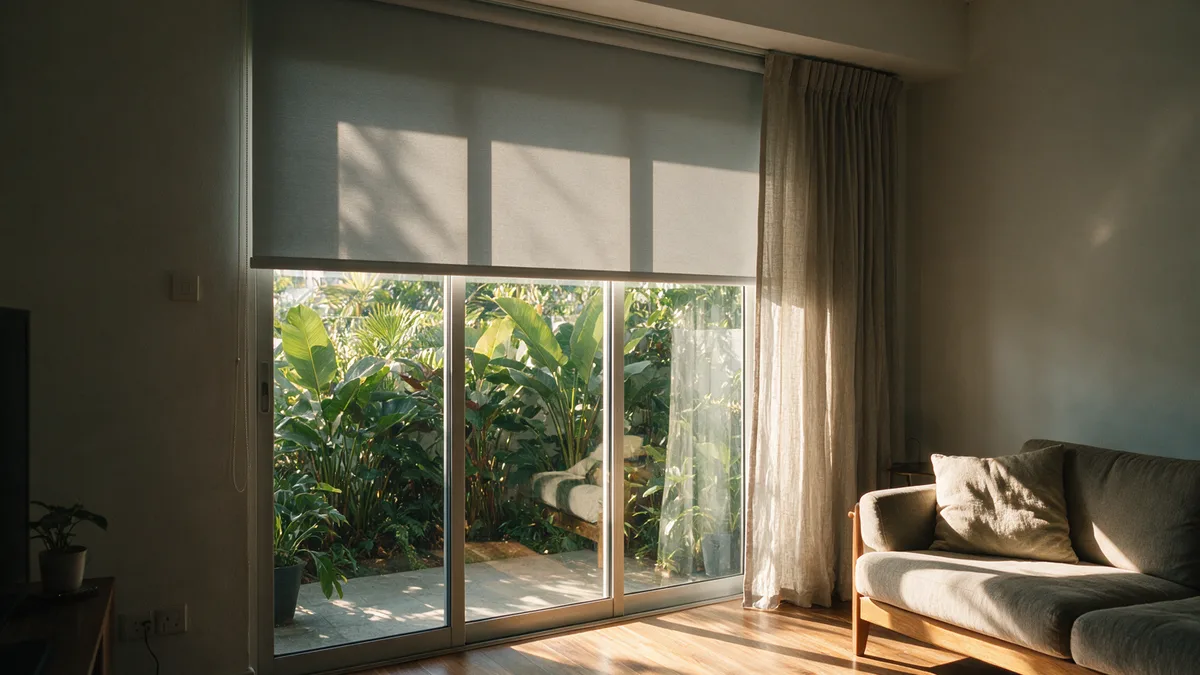
To keep a hot room cool in Malaysia, stop the sun before it reaches the glass. Use an outdoor blind or awning on windows that take the afternoon sun. Indoors, use a dim-out or blackout curtain with a white or reflective backing, and close it before the sun arrives, not after the room is hot. Hang it wide and close to the ceiling so heat cannot slip around the edges.
On this page10
Key takeaways
- In high-rise buildings, direct sun through windows can be 75% to 85% of the heat gained through the building's outer shell, according to the Malaysian Institute of Architects (PAM).
- About 76% of the sunlight that falls on standard double-pane windows enters the room as heat, says the US Department of Energy.
- Shading outside the glass beats shading inside it: the US Department of Energy gives up to 77% less solar heat gain for awnings on west-facing windows, against 33% for medium-coloured draperies with white plastic backings.
- In a terrace house the roof lets in most of the sun's heat (more than 75% in a single-storey intermediate terrace, says PAM), so curtains matter most in condominiums.
- Tenaga Nasional (TNB) advises closing thick curtains in hot weather to take load off the air-conditioner.
Why does a room get so hot in the afternoon in Malaysia?
A room gets hot in the afternoon mainly because sunlight passes through the window glass and turns into heat inside the room. The US Department of Energy, measuring for US homes, says about 76% of the sunlight that falls on standard double-pane windows enters to become heat (US DOE, Energy Efficient Window Attachments). Once inside, that heat warms the air, the floor and the furniture, and the air-conditioner has to work against it.
Windows matter most in condominiums and apartments. The Malaysian Institute of Architects (PAM) notes that in high-rise buildings, heat from direct sunlight through windows can be 75% to 85% of the heat gained through the building's outer shell, depending on how much of the wall is glass (PAM practice note on solar shading). Malaysia gets about 6 hours of sunshine a day, averaged across the year, so shading is a daily job rather than a seasonal one (MetMalaysia).
Afternoon sun is the hardest to handle, because it comes in low through west-facing windows when the day is already at its warmest. A Universiti Teknologi Malaysia computer simulation of a northwest-facing room in Johor Bahru found that fixed concrete shading outside the window lowered indoor air temperature by up to 2.8°C compared with no shading, with the biggest difference between 5pm and 7pm (Chemical Engineering Transactions, 2023). That shows how much outside shade matters in the late afternoon; it is not a measure of what a curtain achieves.
Terrace house or condo? The answer changes with the building. PAM's note finds that more than 75% of the solar heat in a single-storey intermediate terrace house, and more than 50% in a double-storey one, comes in through the roof, so roof insulation does a lot of the work there. In a condominium, the windows are the main way in, so curtains and blinds make a much bigger difference.
Which works better: outdoor blinds or indoor curtains?
Outdoor blinds and awnings keep more heat out than indoor curtains, because they stop the sun before it reaches the glass. An indoor curtain catches the sunlight after it has come through the window, so some of that heat is already in the room. The US Department of Energy says window awnings can reduce solar heat gain by up to 77% on west-facing windows (US DOE).
The same Universiti Teknologi Malaysia paper, summing up earlier research, notes that in general, exterior shading devices are more energy efficient compared to interior shading devices
(CET, 2023). For a balcony or a west-facing glass door, an outdoor roller blind or outdoor wooden blind is usually the strongest single fix.
"We did outdoor blinds for our balcony and it really helps reduce heat in the afternoon."
Karthik Murugan, Promolink customer, in a review on Promolink's website
In a condominium, check with your management body (JMB or MC) before fitting anything outside. Where outdoor blinds are not allowed, the inside layer has to do the work, and the fabric and the way it is hung decide how much heat stays out.
Which heat-blocking curtain or blind fabric keeps the most heat out?
The heat-blocking fabrics that keep the most heat out are dense, light-backed ones: blackout or dim-out curtains with a white or reflective thermal lining, and metallised blinds with an aluminium backing. A light or reflective side facing the glass bounces sunlight back out. A dark, unlined fabric facing the glass soaks up the sun and gives the heat off into the room.
| Fabric or product | What it does | Heat | Best for |
|---|---|---|---|
| Sheer curtain | Softens glare and keeps daylight and privacy by day | Low on its own | Morning light, paired with a heavier layer |
| Dim-out curtain or blind | Blocks most light while the room stays usable | Good, better with a light backing | Living rooms and offices with afternoon sun |
| Blackout blind with side guides or a blackout curtain with a white lining | Blocks light completely; the light side reflects sun back; side guides close the edge gaps | Very good when closed early | Bedrooms and west-facing rooms |
| Metallised (aluminium-backed) screen or blind | Reflects heat while letting some daylight through | Very good | Large glass, offices, rooms where you want the view |
| Outdoor roller or wooden blind | Stops the sun outside the glass | Best | Balconies, patios, west-facing glass doors |
Two numbers on a fabric's spec sheet tell you most of what you need. Promolink's Silent Gliss fabric guide recommends fabrics with a low solar transmission (Ts) value, and a high solar reflectance value (Rs)
, and notes that metallised fabrics have an aluminium backing which significantly increases heat reflection
(heat, light and glare fabrics). Low Ts means less sun gets through; high Rs means more sun bounces back. Screen fabrics are also rated for light transmittance (Tv), and sellers often quote an openness factor, the share of open weave: lower openness means less sun and glare, but less view.
Lining colour makes a measurable difference: studies cited by the US Department of Energy show medium-coloured draperies with white plastic backings can reduce heat gains by 33% (US DOE). The Star's fact-check on heavy curtains adds a warning on dark fabrics: a dark, unlined velvet curtain can reach surface temperatures of up to 49°C in direct sun, and curtains in dark colours facing the glass absorb heat (The Star, March 2026).
Two other options come up often. Honeycomb (cellular) blinds trap air in their cells; the US Department of Energy says cellular shades can reduce unwanted solar heat through windows by up to 80% (US DOE). Window film goes on the glass itself. Whichever you choose, it only works if it is closed before the sun reaches the glass.
Not sure which one your window needs? WhatsApp Promolink a photo of the hot window and say which way it faces.
How should you hang curtains so heat does not leak around them?
Hang heat-blocking curtains wide, high and long, with the light side facing the glass, so sunlight and warm air cannot get round the edges. A good fabric with a gap at the top or sides still lets heat in. The Star's fact-check notes that gaps at the top, sides or bottom of curtains can create convective drafts, and recommends covering the window frame fully (The Star).
- Mount the track close to the ceiling, or use a ceiling-fixed track, so warm air cannot rise behind the curtain.
- Let the curtain run past the window frame on both sides, so the edges overlap the wall.
- Take it down to the floor or well below the sill, so the bottom does not leave a gap.
- Use a double track: a sheer for daytime light and privacy, and a dim-out or blackout layer you close when the sun comes round.
- Put the light or reflective lining towards the glass. The colour facing the room can be anything you like.
When should you close curtains and blinds to keep the room cool?
Close curtains and blinds on any window before direct sun reaches it: east-facing windows in the morning and west-facing windows from early afternoon. The US Department of Energy advises closing draperies on windows receiving direct sunlight to prevent heat gain (US DOE), and in Malaysia that applies every day of the year. For windows facing north or south, watch when direct sun actually lands on the glass and close them for those hours.
Open them again once the sun has left that side of the house, or after sunset. The Star's fact-check found it true that heavy household fabrics can trap heat and restrict airflow (The Star), so a heavy curtain left closed all evening can keep the room warm after the sun has gone. Letting air move through in the evening clears that heat.
If nobody is home to close them, a timer does it for you. Motorised curtains and blinds can close on a schedule before the sun arrives; our guide on whether motorised curtains are worth it in Malaysia explains how they work.
Do curtains and blinds really lower your electricity bill?
Curtains and blinds lower electricity use when they keep sun off the glass, because the air-conditioner has less heat to remove. Tenaga Nasional Berhad (TNB), Malaysia's national electricity company, advises closing thick curtains in hot weather, because less load on the air-conditioner means lower electricity consumption.
"During hot weather, shuttering windows with thick curtains can block out the heat that can overload the air conditioner. The less load on the air conditioner to cool the room, the lower the electricity consumption."
Tenaga Nasional Berhad, Energy-Saving Guidelines During Hot Weather, February 2021
Air-conditioning is a big part of the bill in many homes. In one measured study of 10 apartment households in Kuala Lumpur during hot weather, air-conditioning made up between 19.4% and 52.3% of household electricity use (IJECE, 2017). How much you save depends on the window, the direction it faces and how you use the air-conditioner, so treat any single saving figure with care. The same logic applies in offices and hotel rooms: Promolink's Silent Gliss fabric guide notes that shading fabrics control the amount of sunlight entering a room, minimising the need for artificial cooling, thereby reducing energy consumption
(energy-saving fabrics).
Do blinds protect your furniture, floors and you from the sun?
Yes: closing blinds or curtains in strong sun protects furniture, floors and the people sitting by the window, because UVA rays pass through ordinary window glass. The Skin Cancer Foundation explains that window glass filters out most UVB rays, but UVA rays pass through windows and clouds all year round, and sunlight fades home furnishings and flooring over time (Skin Cancer Foundation).
"UVA rays can penetrate window glass, meaning you can still be at risk of exposure while inside."
Dr Deborah S. Sarnoff, then President of The Skin Cancer Foundation, in a 2020 statement
For rooms with sofas, timber floors or artwork near the window, Promolink's fabric guide recommends fabrics with a low UV value, because prolonged exposure to sunlight damages furniture and surfaces (heat, light and glare fabrics).
Where can you get heat-control curtains and blinds in Kuala Lumpur and Selangor?
Promolink Actions makes heat-control curtains and blinds to measure for homes, offices and hotels, from an office in Petaling Jaya and a showroom in Setapak, Kuala Lumpur. Promolink has made curtains since 1998 and describes itself as the sole gateway to Silent Gliss in Malaysia. Its range includes blackout curtains, dim-out blinds, roller, Roman, zebra and timber blinds, outdoor roller and wooden blinds, and Silent Gliss fabrics chosen for heat, light and glare.
Promolink sews its curtains with in-house specialists and offers free consultation, measurement and installation, with warranty and after-sales care. Browse the Silent Gliss curtain systems, the roller blinds or the project gallery, or contact the team.
Frequently asked questions
Do blackout curtains keep a room cooler?
Yes, if they are closed before the sun reaches the window and the side facing the glass is white or light. A light backing reflects sunlight back out, while a dark, unlined fabric facing the glass absorbs heat. Open them again once the sun has moved off that window, so trapped heat can escape.
What colour curtains keep a room coolest?
The colour facing the glass matters most. A white or light backing reflects sunlight back out: the US Department of Energy cites studies showing medium-coloured draperies with white plastic backings can reduce heat gains by 33%. A dark, unlined fabric facing the glass absorbs heat and, The Star reports, can reach up to 49°C in direct sun. The colour facing the room can be anything you like.
Are outdoor blinds better than indoor blinds for heat?
Yes. Outdoor blinds and awnings stop the sun before it reaches the glass, so less heat gets in. The US Department of Energy puts the cut from awnings at up to 77% of solar heat gain on west-facing windows. In a condominium, check with the management body before fitting anything outside.
Should I close my curtains during the day in Malaysia?
Close them on windows that are getting direct sun: east-facing windows in the morning and west-facing windows in the afternoon. Use a sheer layer on the other windows to keep daylight. Closing them before the sun arrives works far better than closing them once the room is hot.
Will curtains cool a terrace house as much as a condo?
Usually not as much. The Malaysian Institute of Architects (PAM) notes that more than 75% of the solar heat in a single-storey intermediate terrace house, and more than 50% in a double-storey one, comes in through the roof, so roof insulation matters a lot there. In high-rise homes, windows bring in most of the heat, so curtains and blinds make a bigger difference.
What do Ts and Rs mean on a blind fabric?
Ts is solar transmission, the share of the sun's energy that passes through the fabric. Rs is solar reflectance, the share it bounces back. For a hot room, choose a fabric with a low Ts and a high Rs, such as a metallised fabric with an aluminium backing.
Tell us which window gets the afternoon sun
WhatsApp us a photo of the hot window and say which way it faces, and arrange a free consultation and measurement.
WhatsApp usCall 012-292 5582Sources
- Malaysian Institute of Architects (PAM), Practice Note: Solar Shading Devices for Windows in Tropical Climates, December 2009. https://www.pam.org.my/images/news/PAMPracticeNote_Solar_Shading_Devices.pdf
- US Department of Energy, Energy Saver: Energy Efficient Window Attachments (archived copy, September 2021). https://web.archive.org/web/20210925212729/https://www.energy.gov/energysaver/energy-efficient-window-attachments
- Malaysian Meteorological Department (MetMalaysia), Climate of Malaysia. https://www.met.gov.my/en/pendidikan/iklim-malaysia/
- Peng, Tengku Aziz and Leng (Universiti Teknologi Malaysia), The Exploration of Energy Efficient Material for Shading Devices in Tropical Climates, Chemical Engineering Transactions vol. 106, 2023. https://www.cetjournal.it/cet/23/106/051.pdf
- Tenaga Nasional Berhad, Energy-Saving Guidelines During Hot Weather, press statement, 18 February 2021. https://www.tnb.com.my/assets/press_releases/20210237bi.pdf
- Ranjbar et al., Short-Term Measurements of Household Electricity Demand During Hot Weather in Kuala Lumpur, IJECE vol. 7 no. 3, 2017. https://ijece.iaescore.com/index.php/IJECE/article/view/7507
- The Star, QuickCheck: Do heavy curtains trap heat and make rooms feel warmer?, 24 March 2026. https://www.thestar.com.my/news/true-or-not/2026/03/24/quickcheck-do-heavy-curtains-trap-heat-and-make-rooms-feel-warmer
- The Skin Cancer Foundation, UV Window Film and Tint. https://skincancer.org/windowfilm
- The Skin Cancer Foundation, press release, 2020. https://www.skincancer.org/press/2020-sun-protection-and-skin-cancer-awareness-during-covid-19-pandemic/
- Promolink, Heat, light and glare fabrics. https://www.promolink.com.my/products/heat-light-and-glare/
- Promolink, customer reviews on the home page. https://www.promolink.com.my/
- Promolink, Energy saving fabrics. https://www.promolink.com.my/products/energy-saving/