
Roller Blind Sunscreen: What Do 1%, 3% and 5% Openness Mean?
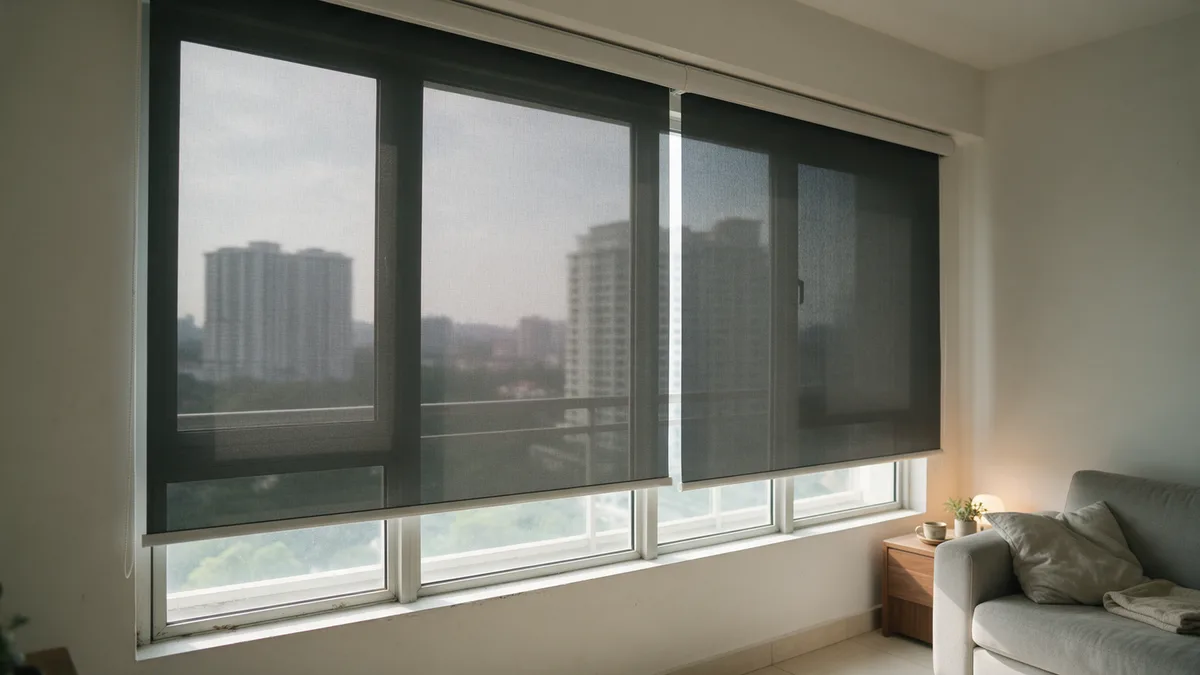
On a Roller Blind Sunscreen, 1%, 3% and 5% is the openness factor: how open the weave is. At 1% and 3% a dark screen controls glare and keeps the view; at 5% the view is clearer but glare control falls away. In Silent Gliss's Basicscreen and Newlifescreen data, night privacy is "medium" at 1% and 3%, "low" at 5%; dark colours give the clearer view, light or metallised ones keep more heat out.
On this page9
Key takeaways
- Silent Gliss rates its darkest Basicscreen colour "very high" for glare control at 1% but "no effect" at 5%, where sight contact with the outside rises from "medium" to "high".
- In Silent Gliss's Basicscreen and Newlifescreen fabrics, night privacy falls as openness rises: "medium" at 1% and 3%, "low" at 5% and "no effect" at 10%, the same in every colour.
- Flamant and colleagues (Building and Environment, 2022) had 50 people rate the view through nine exterior shading fabrics: a dark 3% fabric was judged clearer than light 10% ones.
- Light screens keep more heat out: the share of the sun's energy reaching the room through window and blind (gtot) is 0.38 for the lightest 1% Basicscreen colour, 0.65 for the darkest.
What does 1%, 3% or 5% mean on a Roller Blind Sunscreen?
The percentage on a sunscreen roller blind is its openness factor, which tells you how open the weave is: the lower the number, the more closed the fabric. The open weave lets in the view, and with it light, heat and ultraviolet (UV).
Silent Gliss, whose roller blind systems Promolink supplies, says its screen fabrics are a mesh of opaque yarn with openings for daylight, made with an openness factor usually between 1% and 10%, with 1% being the most 'closed'
(Silent Gliss, screen fabrics). Promolink's Silent Gliss roller blind systems take fabrics from translucent to blackout.
How do 1%, 3%, 5% and 10% compare on glare, view and privacy?
A lower openness gives more glare control and more night privacy; a higher one gives a clearer view. Silent Gliss rates each screen fabric, colour by colour, to the standard DIN EN 14501:2021, on a scale from 0 (no effect) to 4 (very high effect). On that scale a dark 1% or 3% screen scores the highest class for glare control, and a dark 5% screen scores none.
| Openness (Silent Gliss fabric, darkest colour) | Visible light through (Tv) | UV through (Tuv) | Glare control | Sight contact with the outside | Privacy at night |
|---|---|---|---|---|---|
| 1% (Basicscreen 3007) | 2.9% | 2.9% | Very high | Medium | Medium |
| 3% (Newlifescreen 8) | 3.1% | 3.5% | Very high | Medium | Medium |
| 5% (Basicscreen 3007) | 7.2% | 7.2% | No effect | High | Low |
| 10% (Basicscreen 3007) | 16.3% | 16.2% | No effect | Very high | No effect |
Basicscreen comes in 1%, 5% and 10%, so the 3% row is a different fabric, Newlifescreen 3%. Silent Gliss measures the Tv and Tuv values to DIN EN 410, within plus or minus 5% (Basicscreen data, Newlifescreen 3% data).
Does the colour of a sunscreen blind change the view out?
Yes: in Silent Gliss's Basicscreen and Newlifescreen 3%, a dark colour gives a clearer view out than a light one at the same openness. Silent Gliss rates sight contact with the outside one class higher for the darkest Basicscreen colour than for the lightest at every openness: medium against low at 1%, high against medium at 5%, and very high against high at 10%.
A pale screen keeps the room brighter but can hide the view: Silent Gliss's white Newlifescreen 3% passes 33.1% of visible light and rates "high" for daylight utilisation, yet "no effect" for sight contact and glare control. The darkest 1% Basicscreen passes 2.9% and rates "low" for daylight utilisation. In a university study, 50 people judged nine exterior shading fabrics: the higher the openness and the darker the fabric, the clearer the view.
Interestingly, view clarity through the dark-colored fabric with OF=3% was estimated better than that of the light-colored fabrics with OF=10%.
Flamant, Bustamante, Tzempelikos and Vera, Building and Environment, 2022
The same researchers conclude that the EN 14501 classification scheme needs further refinement, so read the classes as a guide.
Can people see in through a Roller Blind Sunscreen at night?
For Basicscreen and Newlifescreen, Silent Gliss rates privacy at night "medium" at 1% and 3%, "low" at 5% and "no effect" at 10%, on a scale whose top class is "very high". In the three fabrics shown, colour does not change the night rating: a darker colour buys a clearer view, not a more private room.
For a bedroom, or a lit unit facing the next tower, add a night layer: Promolink's dim-out blind systems give total room darkening, and for the morning sun, on Promolink's Roller Blind Blackout with side guide channel the side channels block the sunlight from coming into the room. See our guides to blackout curtains and blinds for a bedroom and zebra blinds and roller blinds.
A motorised roller blind can lower the night layer for you: Promolink's motorised roller blinds are controlled with a controller or timer, so the blind can close at a set time each evening. Our guide to motorised curtains covers the controls.
Does a lower openness keep out more heat and UV?
For Silent Gliss's Basicscreen, a lower openness lets less UV through, but the fabric matters too, and for heat the colour matters far more than the openness. The figure to compare is gtot: the share of the sun's energy that reaches the room through the glass and the blind together, calculated by Silent Gliss with a reference glass to DIN EN 13363-1.
How much does the colour change the heat?
For Basicscreen in its lightest colour, gtot is 0.38 at 1%, 0.40 at 5% and 0.43 at 10%; in its darkest, 0.65 at 1% and 5% and 0.66 at 10%. The dark 1% screen lets less of the sun's energy through the fabric (solar transmission, Ts, 2.9% against 20.9%), but absorbs 93.8% and reflects only 3.3%, while the light one reflects 63.6%. Promolink's heat, light and glare page asks for both: a low Ts and a high solar reflectance (Rs).
Does a metallised screen keep more heat out?
A metallised screen combines the two: its aluminium backing, Silent Gliss says, significantly increases the heat reflected back out through the window. Newlifescreen Alu 3% in a near-black colour reflects 59.7% of the sun's energy, with a gtot of 0.39, "very high" glare control and "medium" sight contact. Promolink's sustainability page names its Newlifescreen/Alu fabrics, made entirely from 100% recycled PET bottles.
How much UV gets through?
Across its four colours, Basicscreen lets through 1.9% to 2.9% of UV at 1%, 7.2% to 7.6% at 5% and 14.2% to 16.2% at 10%, but the white Newlifescreen 3% lets through 35.5%. Promolink recommends fabrics with a low UV value to protect furniture, so ask for the Tuv figure; our guide to keeping a hot room cool covers the rest.
Which openness suits a condo living room, bedroom or home office?
Pick by the main problem in each room: a dark 1% or 3% for sun on a TV or laptop, a dark 5% for a view with little direct sun, a light or metallised screen for afternoon sun on west-facing glass, and a night layer in a bedroom. In the Basicscreen figures, 10% gives no glare control and no privacy at night.
| Room and main problem | Start with | Why, from Silent Gliss's figures |
|---|---|---|
| Sun on a TV or laptop screen | 1% or 3%, dark colour | Glare control very high; sight contact medium |
| Living room with a view and little direct sun | 5%, dark colour | Sight contact high; glare control no effect |
| Afternoon sun on west-facing glass that heats the room | A light colour, or a metallised (aluminium-backed) screen | gtot 0.38 to 0.43 for the lightest colour and the metallised screen, against 0.54 to 0.66 for the darkest unbacked colours |
| Bedroom, or a lit unit facing the next tower | A sunscreen for the day plus a dim-out or blackout layer | None of the three fabrics shown rates above medium for privacy at night |
| Wooden floors, fabrics or art in strong sun | 1% to 3%, with a low Tuv on the data sheet | Tuv 1.9% to 2.9% in every Basicscreen 1% colour; 3.5% in the darkest Newlifescreen 3% |
Where can you get a Roller Blind Sunscreen in Kuala Lumpur and Selangor?
Promolink Actions Sdn. Bhd. makes Roller Blind Sunscreen and Roller Blind motorised to measure, on Silent Gliss roller blind systems, from its office in Petaling Jaya and its showroom in Setapak, Kuala Lumpur. It has made curtains and blinds since 1998 and offers free consultation, measurement and installation, with warranty and after-sales care.
Promolink's electric roller blinds page says Silent Gliss motorised roller blinds feature virtually silent operation, programmable intermediate stops and a built-in safety stop if the movement is interrupted. Promolink describes itself as the sole gateway to Silent Gliss in Malaysia. Before you order, ask for the Silent Gliss data sheet (Tv, Tuv, gtot and the EN 14501 classes) of each screen fabric you shortlist.
- Office: A-13A-01, PJ MidTown, Jalan Kemajuan, Seksyen 13, 46200 Petaling Jaya, Selangor.
- Showroom: B-25-08, Residensi MH Platinum 2, No.12, Jalan Usahawan 6, Setapak Jaya 2, 53200 Kuala Lumpur.
- Hours: Monday to Friday, 10am to 7pm; closed on Saturday and Sunday.
Frequently asked questions
Which is more private, a 1% or a 5% sunscreen roller blind?
The 1%, especially at night. Silent Gliss rates privacy at night as medium for its Basicscreen fabric at 1% and low at 5%, the same in all four colours. By day, Silent Gliss says openness factors provide a degree of privacy whilst maintaining an external view. For more privacy at night, add a dim-out or blackout blind behind the screen.
Does a sunscreen roller blind block UV?
Mostly, but the openness is only a guide. Across its four colours, Silent Gliss's Basicscreen lets through 1.9% to 2.9% of UV at 1% openness and 7.2% to 7.6% at 5%. Its white Newlifescreen 3% lets through 35.5%, far more than its openness. Promolink recommends fabrics with a low UV value to protect furniture, so ask for the fabric's Tuv figure.
Is a dark sunscreen roller blind hotter than a light one?
In Silent Gliss's figures, yes. Its darkest Basicscreen colour at 1% lets less sunlight through the fabric but absorbs 93.8% of the sun's energy, and the share that reaches the room through window and blind (gtot) is 0.65, against 0.38 for the lightest colour. A metallised back changes this: Newlifescreen Alu 3% in a near-black colour has a gtot of 0.39.
Can a Roller Blind Sunscreen be motorised?
Yes. Promolink's Silent Gliss roller blind systems run by spring, chain, battery or electric motor, with fabrics from translucent to blackout. Its electric roller blinds page says Silent Gliss motorised roller blinds feature virtually silent operation, programmable intermediate stops and a built-in safety stop if the movement is interrupted, and Promolink's motorised roller blinds are controlled with a controller or timer.
Can people see in through a sunscreen roller blind at night?
For its Basicscreen and Newlifescreen fabrics, Silent Gliss rates privacy at night as medium at 1% and 3%, low at 5% and no effect at 10%, on a scale whose top class is very high, and in these fabrics the colour does not change the rating. For more privacy at night, add a dim-out or blackout blind behind the screen.
Which openness should I choose for a condo?
Start from the main problem in each room. Silent Gliss's figures point to a dark 1% or 3% where sun falls on a TV or laptop, a dark 5% for a view with little direct sun, and a light or metallised screen for afternoon sun on west-facing glass. In a bedroom, add a dim-out or blackout layer for the night, since Basicscreen and Newlifescreen rate no higher than medium for privacy at night.
Ask Promolink to match the screen to your window
WhatsApp Promolink a photo of the window, which way it faces and whether glare, heat or night privacy bothers you most, and arrange a free consultation and measurement.
WhatsApp usCall 012-292 5582Sources
- Silent Gliss, Screen fabrics (openness factors). https://www.silentgliss.co.uk/engb/fabrics/the-collection-by-silent-gliss/screens/
- Silent Gliss, Basicscreen 1%, 5%, 10%: optical and solar values and DIN EN 14501:2021 classes. https://www.silentgliss.co.uk/engb/fabrics/view/basicscreen-1-5-10/
- Silent Gliss, Newlifescreen 3%: optical and solar values and DIN EN 14501:2021 classes. https://www.silentgliss.co.uk/engb/fabrics/view/newlifescreen-3/
- Silent Gliss, Newlifescreen Alu 3%: optical and solar values and DIN EN 14501:2021 classes. https://www.silentgliss.co.uk/engb/fabrics/view/newlifescreen-alu-3/
- Flamant, Bustamante, Tzempelikos and Vera (2022), Evaluation of view clarity through solar shading fabrics, Building and Environment 212, 108750. https://doi.org/10.1016/j.buildenv.2021.108750
- Flamant et al. (2022), abstract on Ingenieria UC (Pontificia Universidad Catolica de Chile). https://www.ing.uc.cl/publicaciones/evaluation-of-view-clarity-through-solar-shading-fabrics/
- Promolink, Roller Blind Systems (Silent Gliss). https://www.promolink.com.my/products/roller-blind-systems-1/
- Promolink, Heat, light and glare (Silent Gliss fabrics). https://www.promolink.com.my/products/heat-light-and-glare/
- Promolink, Sustainability (Silent Gliss fabrics). https://www.promolink.com.my/products/sustainability/
- Promolink, Roller Blind Systems (Electric). https://www.promolink.com.my/products/electric/
- Promolink, Dim-out Blind Systems. https://www.promolink.com.my/products/dim-out-blind-systems/